• 984 394 583 +51 984 394 583 info@coclatours.com
  •       Español        
     Coffee Farm Trek to Machu Picchu 3 days

    Coffee Farm Trek to Machu Picchu 3 days

    3 days - 2 night

    Description

    Most people reach Machu Picchu by train from Ollantaytambo. This 3-day coffee farm trek to Machu Picchu goes the long way, on foot: from the high Andes down into Cusco’s cloud forest, with a night at a family coffee farm where you pick coffee and follow it from the plant to the cup, before continuing to Aguas Calientes. It is a coffee route to Machu Picchu that Coclatours has been building with coffee-growing families since 2009.


    On day one you cross Abra Málaga at 4,316 m, then hike up to a family farm in Huacayupana, where you have dinner and sleep. On day two you spend the morning with the family on their coffee farm, then walk down to the road and continue to Hidroeléctrica, from where you hike along the railway to Aguas Calientes (or take the train). On day three you visit Machu Picchu with a guide. If you want more time on the coffee farm, or a longer walk to the Cocalmayo hot springs, there are two variations of the program: see “Good to know” at the end of the itinerary.


    This trek follows part of the mountain route that the Inca Jungle adventure tours use, but it is a different experience: there is no biking, rafting or zip-lining. Here the coffee farm is not a short stop on the way, it is the heart of the program. You spend the night at or near a family coffee farm and share time with the coffee-growing family, picking and tasting coffee with them. It suits travelers who enjoy walking, have no fear of heights and want to meet a rural family rather than just see a landscape. In the standard version, the uphill hike on day one takes between one and three hours, depending on the farm where we sleep, and on day two you walk about 4.5 hours in total if you hike all the way to Aguas Calientes. You can take the train for the last stretch.


    The old Inca path and its story


    In 1998, floods and landslides destroyed the town of Santa Teresa and left many farming families in the area cut off from the roads. Looking for other ways through the mountains, the local producers explored the slopes and found an old Inca path. They opened it up and have kept it in use since then, and today it lets travelers walk toward Machu Picchu through coffee plantations.


    A stretch of about 1 to 2 km of this path runs alongside a steep slope, so this trek is not suitable for people who have vertigo.


    Want to go deeper into coffee? Read the history of coffee, or write to us about visiting the processing facilities and joining a quality-control tasting. You can also see our coffee and cacao experiences.


    Prefer to include Cusco and the Sacred Valley? See our Coffee Route and Machu Picchu 5 Days program.


    Highlights:


    • Cross the Andes by private vehicle with a coffee stop at 4,300 m
    • Hike through the cloud forest on part of an old Inca path
    • Spend the night at or near a family coffee farm and meet the coffee-growing family
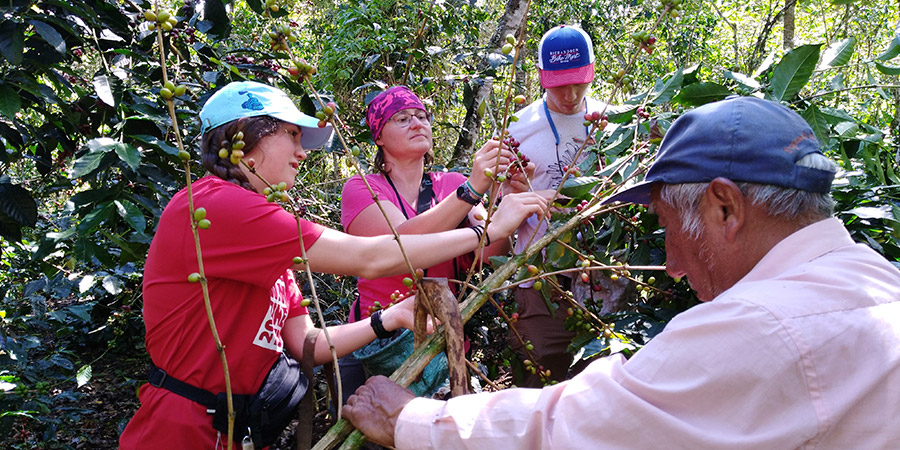
    • Pick coffee and follow it from the plant to the cup
    • Hike along the railway to Aguas Calientes, or take the train, and spend the night at the foot of Machu Picchu
    • Guided visit to Machu Picchu


    Coclatours and the host families


    Coclatours began as part of the COCLA cooperative network, with a clear goal: to involve member families in tourism. In that project, the families received training, financing and promotion to welcome visitors in their own homes. Today Coclatours is a private company, but the work continues: we promote the families and their activities, we bring in families from other areas, and in recent years we have trained families from Lucmabamba and Echarati to improve their visitor experiences, including a visit to Julia’s farm, at our own cost. Read more about our story on our About us page.


    Itinerary


    This is the standard itinerary (hike first). If you want more time on the coffee farm, or a longer walk, see the variations at the end.


    Please note: all times are approximate. This route calls for some flexibility: we adjust the schedule to the road conditions, the hours when the road is open to traffic, the weather and your group’s pace, leaving a little earlier or later when needed to reach the trail or the train on time. The road between Santa María, Santa Teresa and Hidroeléctrica is being improved, with significant progress, and travel times may change.


    Day 1: Cusco – Abra Málaga – Santa María – Huacayupana


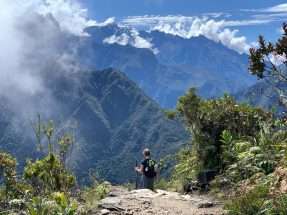
    We pick you up around 7:00 am from your hotel in Cusco, or around 8:30 am from Ollantaytambo, and cross the Andes by private vehicle. The road climbs through the Sacred Valley to Abra Málaga (4,316 m), then drops into the cloud forest. We go slowly: there is time for photos of the snow-capped peaks, for llamas and alpacas along the road, and for a coffee at ELABRA Specialty Coffee & Cacao, a small café at almost 4,300 m run by a young local, Rosmel.


    We reach Santa María around midday for lunch (included). Optional: have lunch at Julia’s organic farm along the way, meet the family and taste seasonal fruit. Ask us when you book.


    From Santa María, we continue to the trailhead and start the hike to Huacayupana, a hillside of small family farms. The climb takes between one and three hours, depending on the farm where we sleep, and follows farm terraces and part of an old Inca path. (Not recommended if you are afraid of heights.)


    The family welcomes you in the afternoon. After some rest, we share dinner with them and spend the evening at their table.


    Overnight: family farm, private room with hot water.


    Day 2: Coffee Farm – Hidroeléctrica – Aguas Calientes


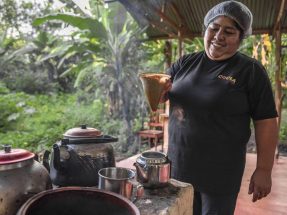
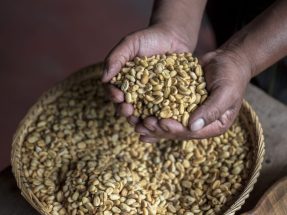
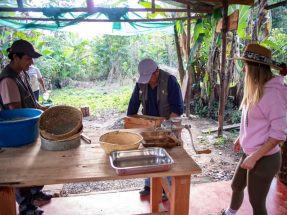
    We start early with breakfast with the family. A member of the family guides you around the farm, and you follow coffee from the plant to the cup: picking, pulping, drying and selecting the beans, and finally tasting a cup prepared in the traditional way.


    Harvest depends on the season. Most of the year there are ripe cherries to pick; if there are none, the rest of the experience runs as usual.


    Around 11 am, we say goodbye to the family and walk down to the road, about 1.5 hours. A vehicle then takes us straight to Hidroeléctrica, passing through Santa Teresa, about 50 minutes away depending on the state of the road, where we have lunch (not included). From there, you choose how to reach Aguas Calientes:


    • Hike along the railway (recommended): about 10 km, around 3 hours (approximate, depending on your pace), with your guide. It is a beautiful route. We recommend leaving Hidroeléctrica around 2 pm, and 3 pm at the latest, so you do not finish too late.
    • Take the afternoon train (optional): available on request, at an additional cost. Tell us when you book.


    In Aguas Calientes, your guide explains the plan for Machu Picchu, and you have the evening free, with the hot springs if you want them.


    Overnight: hostel in Aguas Calientes with private bathroom and hot water.


    Day 3: Machu Picchu – Return to Cusco


    We take the bus up to Machu Picchu in the morning and tour the citadel with your guide. Then you have free time to explore and take photos on your own. Huayna Picchu or Machu Picchu Mountain can be added if you book in advance, as spaces are limited.


    After lunch outside the site (food is not allowed in the citadel), we take the bus back down to Aguas Calientes, then the train to Ollantaytambo and a transfer to Cusco, arriving at night. You will know your exact train schedule as soon as we buy your tickets.


    Good to know: more time on the coffee farm, or a longer walk


    This program is flexible. We choose the host family according to your travel dates and availability. If your priority is to spend more time on the coffee farm, or to walk more, we offer a coffee-first version, with two options for the walk on day 2:


    • Day 1, coffee first: we cross Abra Málaga by private vehicle and go straight to the coffee farm, arriving for lunch with the family (included). The afternoon is for the full coffee experience, with more time than in the standard version. Dinner and night in a local lodge near the river, private room with hot water.
    • Day 2, option A: Inca path and railway: we leave the lodge around 7:30 am. After a drive of about 25–30 minutes to the trailhead, we walk the Inca path up and down, about 3 hours and a bit more demanding. Then we continue by vehicle to Hidroeléctrica, arriving around midday for lunch (not included), and you choose between the hike along the railway (about 10 km, around 3 hours) or the afternoon train to Aguas Calientes.
    • Day 2, option B: a full day to Cocalmayo (with the Pérez family): this option is done with the Pérez family. If your priority is the walk, we leave the lodge around 7 am and start walking around 8 am, following rural paths and the Inca path all the way to Santa Teresa. The walk takes about 7 to 8 hours with stops, with lunch on the way (not included). In the late afternoon we reach Cocalmayo, where you can visit the hot springs (entrance not included), and we spend the night in Santa Teresa in a simple guesthouse with hot water.
    • Day 3, option B: we take the early-morning train from Hidroeléctrica to Aguas Calientes (around 7:45 am) and go up to Machu Picchu, with entry around 10:00 am, subject to availability. The train ticket is required in this option (see below). After the visit, we return to Cusco as in the standard program.


    Option A is a longer walking day: about 3 hours on the Inca path, plus around 3 hours along the railway if you hike. The train is a good choice for the last stretch. Option B is the longest walking day, about 7 to 8 hours, and it replaces the night in Aguas Calientes with a night in Santa Teresa. In option B, the train ticket from Hidroeléctrica to Aguas Calientes is required and is an additional cost of about USD 40 per person. We buy it together with your return ticket to Ollantaytambo, to keep the cost down.


    Option B depends on Machu Picchu entry availability: after the early train, it needs an entry time around 10:00 am or later. If only earlier entry times are available for your date, we will propose the standard version or option A, which sleep in Aguas Calientes and allow an early entry. In all versions, the program lasts three days and includes Machu Picchu on day three. We will confirm the plan with you when you book.


    Price


    We are updating the prices for this 3-day program. Write to us with your travel dates and the number of travelers, and we will send you a quote.


    Included

    Includes


    • Private transportation from Cusco or Ollantaytambo to the trailhead and Hidroeléctrica
    • Bilingual guide (Spanish – English)
    • 1 night with a host family or in a local lodge near the river, private room with hot water, plus dinner and breakfast
    • Coffee experience with the family
    • Lunch on day 1
    • 1 night in a hostel in Aguas Calientes with private bathroom and hot water + breakfast. The one we include is Terrazas del Inca Hostel or similar
    • Round-trip bus ticket to Machu Picchu
    • Machu Picchu entrance ticket (circuit subject to availability at the time of booking)
    • Guided visit to Machu Picchu (shared or private, depending on your request)
    • Train ticket from Aguas Calientes to Ollantaytambo
    • Bus from Ollantaytambo to Cusco, and transfer from the bus station to your hotel


    Hidroeléctrica to Aguas Calientes: the program includes the hike (about 10 km, around 3 hours, along the railway). If you prefer the train, tell us when you book, and we will add the ticket at an additional cost.


    Cocalmayo option: the night in Santa Teresa (simple guesthouse, hot water, breakfast) replaces the night in Aguas Calientes. The train ticket from Hidroeléctrica to Aguas Calientes is required in this option and is an additional cost of about USD 40 per person.


    Does not include


    • Breakfast on day 1
    • Lunch on day 2 and day 3, and dinner on day 2 (in Aguas Calientes, or in Santa Teresa in the Cocalmayo option)
    • Train ticket from Hidroeléctrica to Aguas Calientes (optional in the standard version, required in the Cocalmayo option, about USD 40 per person)
    • Entrance to the Cocalmayo hot springs
    • Additional costs caused by changes due to weather or road conditions
    • Snacks, water, and personal expenses
    • Entrance ticket to Huayna Picchu or Machu Picchu Mountain, upon request and subject to availability
    • Tips
    • Services not mentioned


    Recommendations

    How demanding is it?


    This is a moderate trek for people who are comfortable walking for several hours. You do not need technical experience, but you do need a reasonable level of fitness:


    • Standard version: on day 1 you hike uphill for one to three hours to the farm. On day 2 you walk about 1.5 hours down to the road and, if you choose to hike to Aguas Calientes, around 3 more hours (10 km) along the railway.
    • Coffee first, option A: day 2 includes about 3 hours on the Inca path, plus around 3 hours (10 km) along the railway if you hike.
    • Coffee first, option B (Cocalmayo, with the Pérez family): about 7 to 8 hours of walking on day 2, with stops, and the train from Hidroeléctrica the next morning.
    • If you prefer, you can take the train for the last stretch to Aguas Calientes.
    • A stretch of about 1 to 2 km of the Inca path runs alongside a steep slope, so this trek is not recommended if you are afraid of heights.


    Altitude


    Cusco is at about 3,400 m, and the road crosses Abra Málaga at 4,316 m. We recommend arriving in Cusco at least one or two days before the trek, to adapt to the altitude. Drink plenty of water and take it easy on your first day. The farms are lower, at about 1,700 to 1,800 m, in a warmer area with mosquitoes.


    What to bring


    • A small daypack
    • Hiking shoes or boots with good grip
    • Rain jacket or poncho (even in the dry season)
    • Light layers for the walk and a warm layer for Abra Málaga and the evenings
    • Long trousers and a long-sleeved shirt, to protect against mosquito bites
    • Sun hat and sunscreen
    • Insect repellent, and an antihistamine: repellents do not always work, and bites can itch and swell
    • Headlamp or flashlight (the walk along the railway can end near dusk)
    • Reusable water bottle (you can refill it at the host family’s home) and some snacks
    • Cash in soles for small purchases and tips
    • Your passport (needed for Machu Picchu)
    • Swimsuit, if you want to use the hot springs in Aguas Calientes or Cocalmayo
    • Any personal medication you need


    Best time to go


    The dry season, from about May to October, is the best time for this route. The rainy season runs from about December to March, and we do not recommend this route in those months because of the mud and the risk of landslides on the road. Within the rainy season, some weeks are worse than others and some are calmer, so ask us about the conditions for your dates. Weather in the cloud forest can change quickly at any time of the year: even in the dry season, a heavy downpour can fall without warning, so we stay flexible and adjust the plan to the conditions of the day. The road between Santa María, Santa Teresa and Hidroeléctrica is being improved, with significant progress, but conditions can still change. Ripe coffee cherries are available most of the year, with fewer between December and March.


    If the plan has to change


    Weather and road conditions in the cloud forest can force changes to the plan. If this happens, we will let you know and look for the best option to meet the goals of the trip. Any additional costs caused by these changes are not assumed by Coclatours and must be covered by the traveler. See our Terms & Conditions for details.


    When you book


    • Book as early as you can: Machu Picchu entrance tickets and train seats are limited, especially in high season (about June to August).
    • The Machu Picchu entry time and the train seats decide which version of the program is possible for your dates, so we confirm the version with you based on availability.
    • Send us each traveler’s full name and passport number exactly as in the passport, to issue the tickets.
    • Tell us about any dietary needs or health conditions that may affect the walk.
    • Times in this program are approximate: we confirm the plan with you before the trek and adjust it to the road and weather conditions.


    Related Post

    To receive our best monthly deals

    JOIN THE NEWSLETTER