

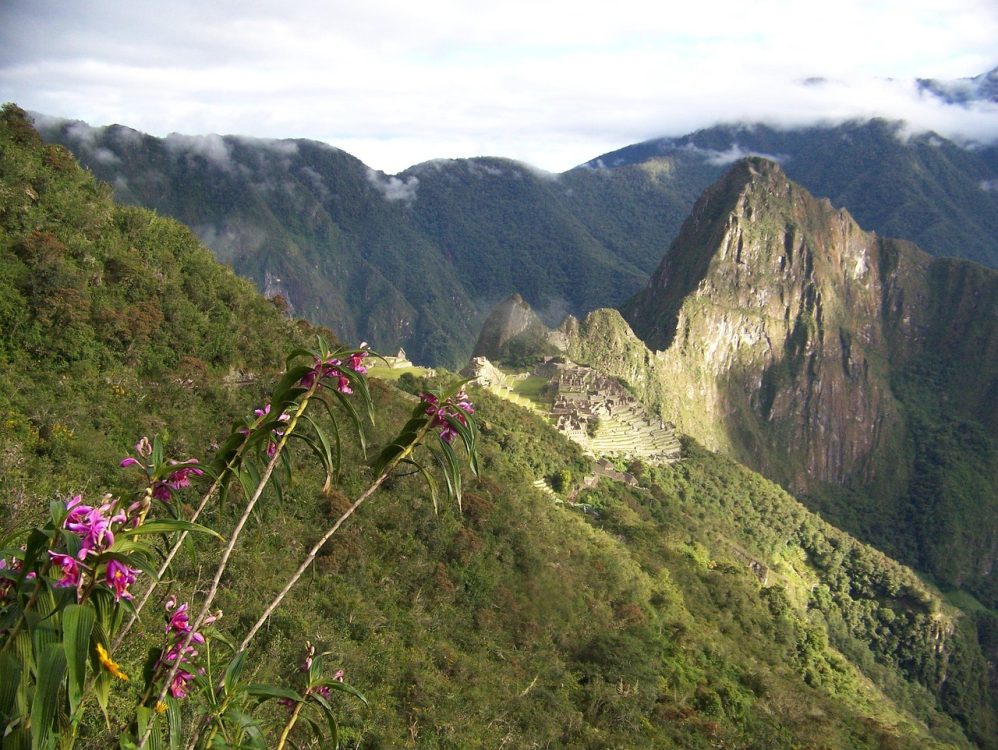
Machu Picchu Guide 2026: Circuits, Tickets & Expert Tips”
: Saturday, 30 May, 2026 | BlogUpdate – September 2026: Peru’s Ministry of Culture has introduced new rules for buying and using Machu Picchu tickets. Tickets are now personal, paid in full at purchase, and cannot be changed or refunded. See what changes for you.
Since June 2024, visiting Machu Picchu has changed significantly. To protect this UNESCO World Heritage Site and manage more than 1.5 million visitors a year, Peru’s Ministry of Culture introduced a system of circuits and timed entries, and in 2026 it added new ticket rules. Here’s everything you need to know to plan your visit.
Why the Circuit System?
Gone are the days of general admission to Machu Picchu. The citadel is now divided into three main circuits with 10 specific routes. Each visitor chooses a circuit when buying their ticket and follows that route throughout the visit. The system was created to:
- Protect the archaeological site from over-tourism and deterioration
- Improve visitor flow and reduce congestion
- Preserve structures and pathways for future generations
- Follow UNESCO recommendations for World Heritage protection
The 3 Main Circuits Explained
All routes are one-way with no turning back, and your circuit, route and entry time are printed on your ticket. You and your guide can only visit the route shown on it, and each route has a maximum time you can stay inside.
Circuit 1: Panoramic Circuit
- Best for: Travelers seeking iconic photos and scenic views from elevated positions
- Duration: About 1.5 hours for the panoramic route; longer on routes that include a hike
- Difficulty: Moderate
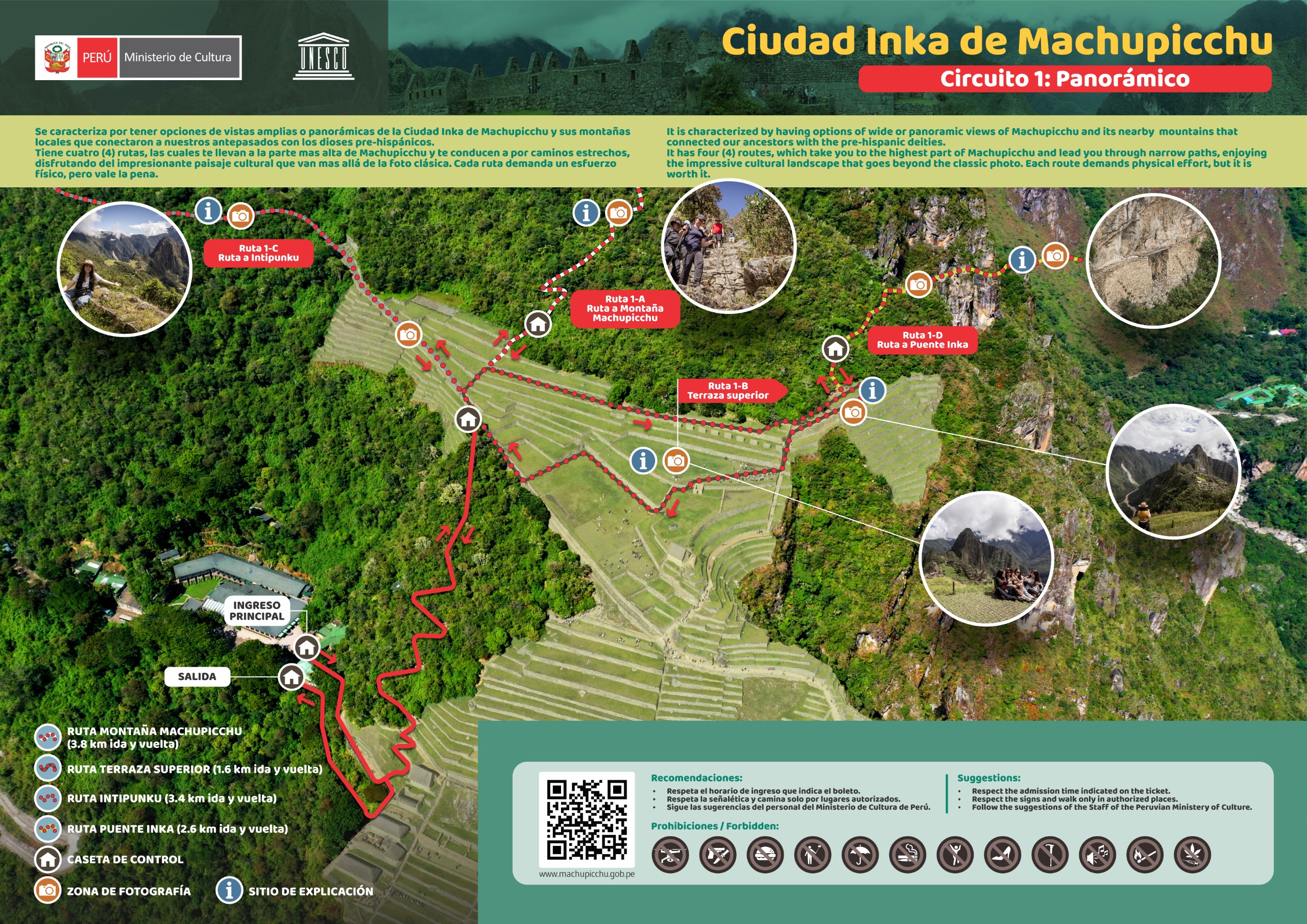
Image: Ministerio de Cultura del Perú · Source: machupicchu.gob.pe
Circuit 1 focuses on the upper terraces and mountain viewpoints. You’ll reach the Upper Terrace, also known as the Guardian’s House area, where the classic postcard photo of Machu Picchu is taken. From above, you’ll see the Temple of the Sun, the Temple of the 3 Windows, the Sacred Plaza and the iconic Huayna Picchu mountain. Circuit 1 does not go down into the lower part of the Inca city.
Circuit 1 has four routes: Route 1-A includes the climb to Machu Picchu Mountain (higher price, limited capacity); Route 1-B (Upper Terrace) is the classic panoramic route, available year-round; Route 1-C (Inti Punku / Sun Gate) and Route 1-D (Inca Bridge) are only available in high season.
Important note: If your main goal is the classic postcard photo from the Guardian’s House, choose Circuit 1 or Circuit 2. Circuit 3 does NOT include this view, and it’s a common booking mistake.
Circuit 2: Classic Circuit (Recommended)
- Best for: First-time visitors, history lovers and anyone wanting the most complete experience
- Duration: About 2.5 hours (maximum stay: 2 hours 30 minutes)
- Difficulty: Easy to moderate (family-friendly)
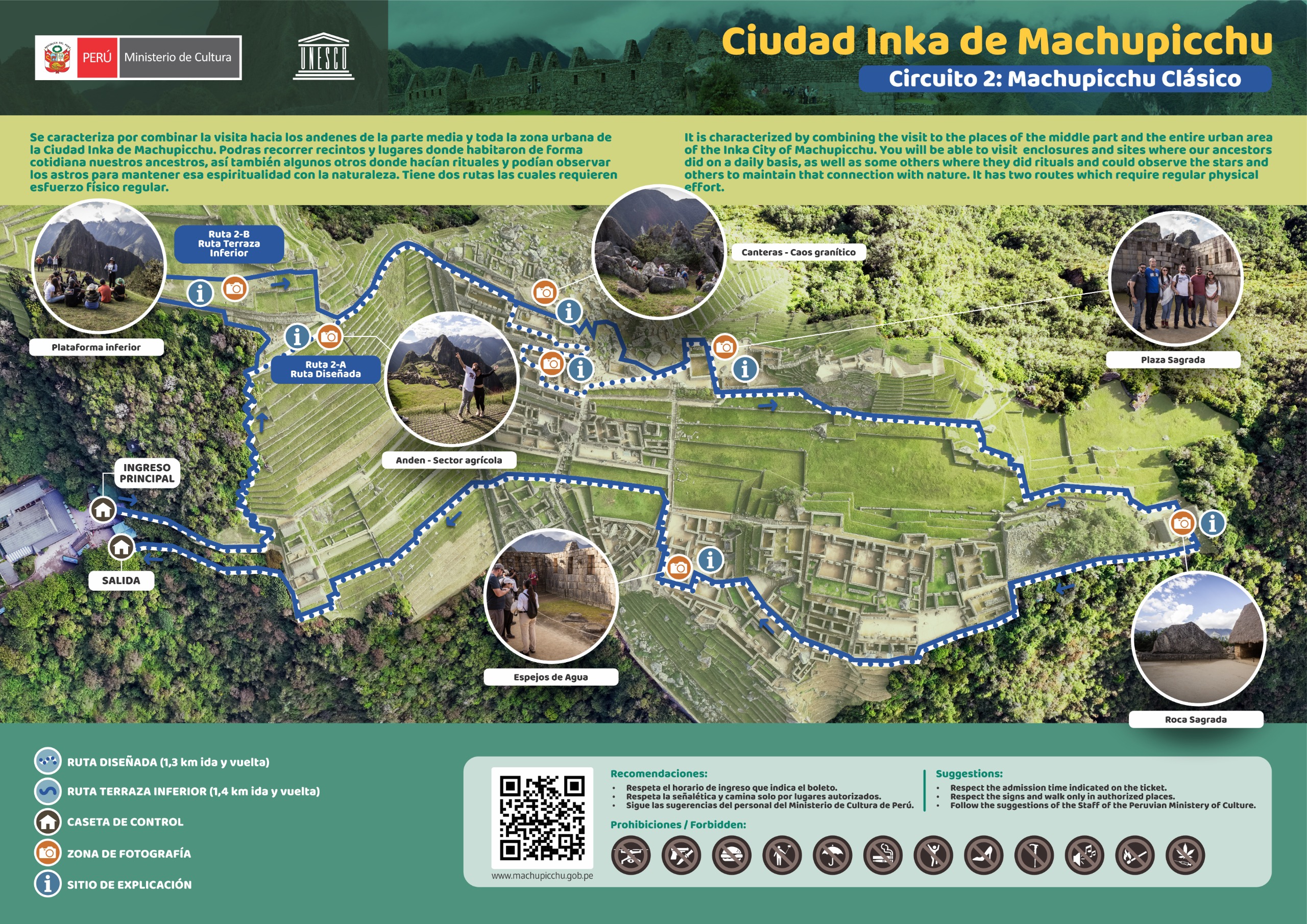
Image: Ministerio de Cultura del Perú · Source: machupicchu.gob.pe
Circuit 2 is the most popular choice for good reason. It is the only circuit that combines the classic postcard view with a walk through the heart of the Inca city. You’ll see the Main Plaza, the Temple of the Sun (from a viewpoint), the Temple of the 3 Windows, the Sacred Rock, the Temple of the Condor and the agricultural sector.
Two routes exist: Route 2-A (Classic Designed Route) is the most comprehensive and includes the Upper Terrace for the classic photo. Route 2-B (Lower Terrace) takes you to a lower viewpoint for a slightly different version of the classic photo, then through most of the same sites.
Reality check: Circuit 2 tickets sell out extremely fast, especially in high season. Book at least 2 months in advance, and 3–4 months for July and August. If Circuit 2 is sold out for your date, a good alternative is to buy two tickets for the same day, such as Route 1-B plus Route 3-B, at compatible times.
Circuit 3: Royalty Circuit
- Best for: Travelers interested in Inca religious and royal architecture, and those who want to climb one of the mountains
- Duration: About 2 hours for Route 3-B; longer on routes that include a hike
- Difficulty: Easy (3-B) to high (3-A)
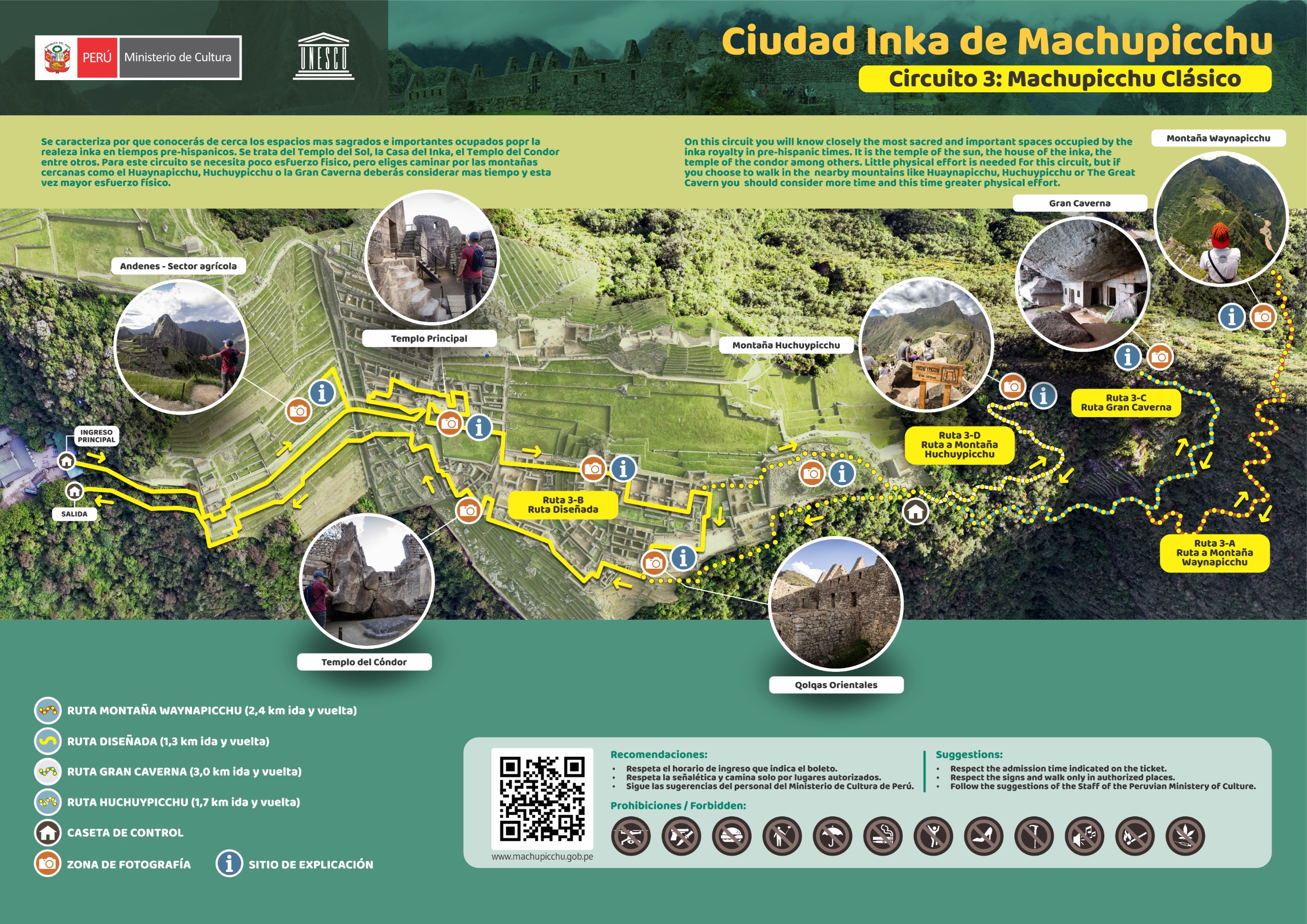
Image: Ministerio de Cultura del Perú · Source: machupicchu.gob.pe
Circuit 3 focuses on the most sacred spaces once used by the Inca nobility, such as the Temple of the Sun, the House of the Inca and the Temple of the Condor. It is also the circuit for the climb to Huayna Picchu (also spelled Waynapicchu), the steep peak behind the classic Machu Picchu photo.
Circuit 3 has four routes: Route 3-A (Huayna Picchu climb) has two entry times a day, at 7:00 and 10:00 AM, with 200 tickets each (400 per day), so it often sells out months in advance; Route 3-B (Royalty Route) is available year-round and is also the entry route for Inca Trail hikers; Route 3-C (Great Cavern / Temple of the Moon) and Route 3-D (Huchuy Picchu, a shorter and easier climb than Huayna Picchu) are only available in high season.
Age limits apply to the mountain and cavern routes (3-A, 3-C and 3-D), and younger travelers may be restricted or must be accompanied by an adult. If you’re traveling with teenagers, ask us before booking so we can confirm the current rule for your route.
Critical warning: No Circuit 3 route, including Huayna Picchu, gives you the classic postcard photo from the Guardian’s House. Many travelers book it for that reason and only discover on the day that they won’t get the iconic view.
New Ticket Rules for Machu Picchu (Updated September 2026)
In September 2026, Peru’s Ministry of Culture introduced new rules for buying and using Machu Picchu tickets. They are being phased in: first a short platform adjustment period, then a 30-day trial run, after which they become mandatory. Here’s what changes for you:
Tickets Are Personal and Fixed
Every ticket is issued in your name with your full passport number, and it is valid only for the date, time slot, circuit and person shown on it. You cannot change the date or transfer the ticket to someone else. The only correction allowed is to your passport number, once, and only for an obvious typing error. That’s why we’ll ask you for a photo of your passport before we buy your ticket.
Full Payment at the Time of Purchase
Tickets can no longer be reserved and paid later. They are paid in full at the moment of purchase, either on the Ministry of Culture’s official platform (tuboleto.cultura.pe) or through an authorized tour operator. If you book a Machu Picchu tour with Coclatours, we buy your ticket for you as soon as you confirm, after checking your passport details and helping you choose the right circuit and time slot.
Unused Tickets Are Lost
If you miss your date or entry time, the ticket loses its validity. There is no rescheduling and no refund, except in documented cases of force majeure. Before paying, double-check your date, time slot, circuit and passport details, and consider travel insurance that covers trip interruption.
Buying Tickets in Person
Up to 1,000 tickets a day are sold in person at the Ministry of Culture office in Machu Picchu Pueblo (Aguas Calientes), for a visit the following day. They sell out fast, especially in high season, so we only recommend this option if you can stay at least two nights in Aguas Calientes.
If You Hike the Inca Trail
After finishing the Inca Trail, you enter the citadel through Route 3-B, which is set as part of your permit. Once the trek begins, groups cannot merge with other groups, even within the same company.
Seasons, Capacity and Best Times to Visit
- High season: Roughly from late June to early November, plus Holy Week (Easter), New Year’s Day and the last days of December. Exact dates change every year and are set by the Ministry of Culture, usually toward the end of the previous year. Up to 5,600 visitors per day, and the seasonal routes (1-C, 1-D, 3-C and 3-D) are open. Crowds are biggest and Circuit 2 sells out first, so book at least 2 months in advance.
- Regular season: The rest of the year. Up to 4,500 visitors per day and fewer routes, but also fewer people. You can often book 2–3 weeks ahead.
- Weather: The dry season runs roughly from May to September. From December to March expect frequent rain, but also greener landscapes.
- Time of day: Midday (11 AM–1 PM) is usually the most congested. Early-morning and mid-afternoon slots tend to feel calmer.
These daily limits include the 1,000 tickets sold in person in Aguas Calientes; the rest are sold online.
Important Rules and Requirements
Opening hours and entry slots: Machu Picchu is open from 6:00 AM to 5:00 PM. Most routes have hourly entry slots from 6:00 AM to 3:00 PM.
Late arrival: After the time on your ticket, you have 30 minutes to enter in regular season and 45 minutes in high season. After that, you won’t be admitted. Mountain hikes (Huayna Picchu, Huchuy Picchu and Machu Picchu Mountain) have no tolerance at their own checkpoint, so plan to arrive early.
Maximum stay: Each route has a maximum time inside (for example, 2 hours 30 minutes on Circuit 2). Staff can remove visitors who exceed it.
Official guide: Visits to the citadel must be made with an official licensed tour guide, in groups of up to 16 people per guide. A guide is not required for the mountain hikes.
Circuit adherence: You must follow your assigned route exactly. Park rangers enforce this strictly. Leaving your route can result in immediate expulsion without refund, and your guide may also be sanctioned.
No re-entry: Tickets are for a single entry. Once you exit, you cannot go back in on the same ticket.
Documentation: Bring your original physical passport, the same one whose number appears on your ticket. Photocopies and photos of your passport are not accepted. A digital copy of your ticket is enough; printing is optional.
Children: Children under 3 enter free, and the minor rate applies from 3 to 17 years old. Minors must be accompanied by an adult.
What You Can’t Bring
Large backpacks, food, alcohol, tripods, umbrellas and single-use plastics are not allowed. Bring a small daypack, a reusable water bottle and a rain poncho instead. Smoking, climbing on walls or terraces, loud noise and leaving the marked paths are also prohibited, and all trash must leave the site with you.
Common Mistakes to Avoid
- Mistake #1: Choosing the wrong circuit. The most common error is booking Circuit 3 for the classic postcard photo, which Circuit 3 doesn’t include. Solution: choose Circuit 1 or 2 if photos matter to you.
- Mistake #2: Booking too late. Circuit 2 sells out months in advance in high season. Book at least 2 months ahead, and ideally 3–4 months for July and August.
- Mistake #3: Sending the wrong passport details. Tickets are personal and only one correction to the passport number is allowed. Send your details exactly as they appear in your passport, and travel with that same physical passport.
- Mistake #4: Not coordinating logistics. Your train (from Poroy station near Cusco, about 3.5 hours, or from Ollantaytambo, about 1.5–2 hours), your arrival in Aguas Calientes, the bus up to the citadel (about 25 minutes, plus waiting time in the bus line) and your entry time all need to fit together. With only 30–45 minutes of tolerance and no refunds, a missed slot means a lost ticket.
- Mistake #5: Underestimating the altitude. Machu Picchu sits at 2,430 meters (7,970 feet) and Cusco at 3,400 meters. Spend 2–3 days acclimatizing before your visit. Bring sunscreen (SPF 50+), enough water, warm layers and insect repellent.
- Mistake #6: Arriving without cash. Many places accept cards, but carrying Peruvian soles is wise for restrooms (located outside the entrance), water and small purchases.
Pricing and Discounts
Machu Picchu ticket prices vary by circuit and visitor category, and are charged in Peruvian soles. As a reference, in 2026 a foreign adult pays about S/152 for the citadel ticket on a standard route, and more for routes that include Huayna Picchu, Machu Picchu Mountain or the Great Cavern. Since May 2026 there is also a separate Historic Sanctuary fee of S/11 for foreign adults and S/5 for foreign visitors aged 3 to 17. Students and minors pay reduced citadel rates, and prices are lower for Peruvian nationals, citizens of the Andean Community (Bolivia, Colombia and Ecuador) and foreign residents in Peru.
The student rate applies to undergraduate students under 25 on the day of the visit, with a valid, physical university or institute ID card that must be shown at the entrance together with the passport. The international ISIC card is no longer accepted, and neither are master’s or PhD cards, enrollment certificates or library cards. If you’re a student, send us a photo of your card when you book so we can confirm it qualifies before buying your ticket.
Prices can change, so always check the official Ministry of Culture website (tuboleto.cultura.pe) for current rates.
The Journey to Machu Picchu
Getting to Machu Picchu requires planning. From Cusco, you can take the train from Poroy station (about 3.5 hours), or drive to Ollantaytambo in the Sacred Valley and take the train from there (about 1.5–2 hours). From Aguas Calientes, a bus takes you up to the citadel in about 25 minutes. Inside Machu Picchu, plan for 2–3 hours depending on your route.
A good tour operator buys your train and entry tickets as soon as you confirm, and times your train, bus and entry slot so everything fits together.
A Different Way to Reach Machu Picchu: Through Cusco’s Coffee Valley
Most travelers reach Machu Picchu by train through the Sacred Valley. But on the other side of the mountains lies La Convención, the province where Cusco’s coffee and cacao are grown, and the alternative route to Machu Picchu through Santa Teresa and Hidroeléctrica runs right through it.
This is our home region. Since 2009 we have worked with local farming families here, and we’ve designed trips that combine a stay on a family-run farm with your visit to Machu Picchu. Explore our Coffee Route and Machu Picchu 5 Days program or the Inca Jungle Coffee Trail towards Machu Picchu 2D.
Why Book with a Professional Guide
A licensed guide is required inside the citadel, but the right guide makes a real difference. A good guide gives you the historical context and archaeological insight that bring the site to life: the meaning of the temples, the sophistication of the water system and the role Machu Picchu played in the Inca Empire.
A local operator also helps you choose the route that best matches your interests and fitness level, checks your passport and student details before the ticket is issued, and buys your tickets as soon as you confirm, which matters most in high season. No one can guarantee availability, but booking early with the right information gives you the best chance of getting the route and time you want.
Planning Your Visit
Start planning at least 2 months in advance, and 3–4 months if you’re traveling in July or August. Decide which circuit suits you best (photos, history or adventure), have your passport details ready, and book your tickets accordingly.
Spend 2–3 days in Cusco beforehand to acclimatize. Pack for changing weather, bring water, and wear comfortable walking shoes.
Most importantly, respect the site’s fragility. Follow your assigned route, stay on marked paths, and treat this World Heritage Site with the care it deserves. Machu Picchu is a remarkable testament to Inca engineering, and protecting it ensures future generations can experience it too.
Looking for a way to get there? Explore our classic Machu Picchu tours, our treks to Machu Picchu, or combine your visit with a day on a family-run farm through our coffee and cacao experiences.
For help planning your Machu Picchu trip with expert guides and coordinated logistics, contact Coclatours on WhatsApp at +51 984 394 583 or by email at info@coclatours.com.