

Short History of Coffee
: Wednesday, 16 September, 2026 | BlogHow coffee reached Peru
Coffee’s story begins far from Peru, in the highlands of Ethiopia, where legend says a goat herder named Kaldi discovered the plant after noticing his goats became unusually energetic after eating its red berries. From there, coffee spread through Yemen and the Arab world, and eventually across Europe.
Coffee arrived in South America with European colonists in the 18th century. By the mid-1700s, it was already being grown in Cusco, along with Chanchamayo, Moyobamba, Jaén, and Huánuco, mostly for local consumption, with some exported to Germany, Britain, and Chile.
Today, Peru grows coffee across 10 different regions, from the northern jungle to the southern Andes. Most of it comes from small family farms, and Peruvian coffee is especially known internationally for its organic quality. It is grown mostly between 600 and 1,800 meters above sea level, often using traditional, chemical-free farming methods passed down through generations. Specialty coffee, in particular, is usually grown above 1,300 meters, exactly the range found on the mountain slopes of La Convención, in Cusco.
Cusco’s own coffee: over 100 years of tradition
Cusco alone has over 53,000 hectares dedicated to coffee, producing more than 30,000 tons every year. In the La Convención valley, coffee has been grown for more than a century, and it’s not just any coffee. This region is home to “Café Machu Picchu-Huadquiña,” one of only two coffees in Peru with an official Denominación de Origen (a legal recognition, similar to how Champagne or Parmesan cheese are protected). It protects coffee grown in Huadquiña, in the Santa Teresa district, the same valley the Inca Jungle Trail crosses on its way to Machu Picchu.
A young farmer who changed everything
For years, coffee farmers in Cusco tried to improve their craft. Some traveled to other regions to learn new techniques, but the impact back home was always small: a few better harvests, nothing that changed the region as a whole.
Something similar had already happened elsewhere in Peru. In 2010, Wilson Sucaticona, a small-scale farmer from Puno, saw his Tunki coffee named “Coffee of the Year” at a major specialty coffee competition in the United States. That single win sparked a wave of interest in specialty coffee across the Puno region that lasted for years.
In Cusco, that same kind of turning point came with Dwight Aguilar, a young farmer from Santa Teresa. Growing up, Dwight had dreamed of studying agronomy in the city, but family hardship, including a natural disaster that swept through the valley in 1998 and his mother’s illness, kept him working the land instead. He taught himself the craft from books and videos, determined to perfect what his family had always grown.
In 2018, Dwight won Peru’s own Taza de Excelencia (Cup of Excellence) with a Geisha and Bourbon coffee grown on his family farm, Nueva Alianza. Geisha (also spelled “Gesha,” after the Ethiopian village where it was first found) is one of the most prized coffee varieties in the world. In 2021, he won again, becoming the first producer in Peru’s history to win the title twice.
Just as Sucaticona’s win had done in Puno, Dwight’s victory changed how his entire valley saw its own coffee. Farmers who had always grown it simply as a crop began to see it as something worth perfecting, sparking a wave of interest in specialty coffee across La Convención and the wider Cusco region that continues today. Dwight is still pushing boundaries: he is recognized as one of the first growers to cultivate the rare Yellow Geisha variety, and his coffee is exported to specialty roasters as far away as New York.
Taste it where it grows
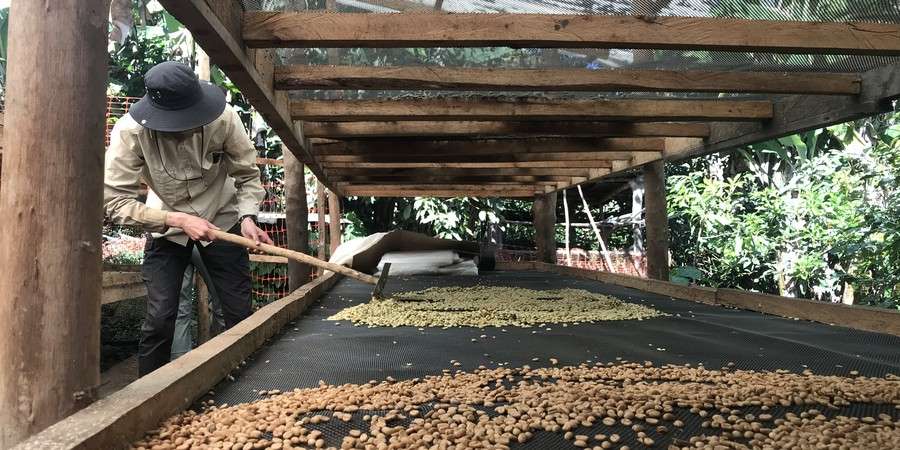
Reading about coffee is one thing. Meeting the family who grows it, picks it, and roasts it by hand is another. On our Inca Jungle Coffee Trail and coffee farm tours, you’ll walk through farms in this same historic valley, join the harvest, and enjoy a cup prepared using traditional methods: coffee with over a hundred years of history, from a valley now recognized for some of the finest coffee in Peru.
Sources
- PROMPERÚ (Cafés del Perú) — official Peru coffee growing regions and altitude data
- Indecopi — Denominación de Origen “Café Machu Picchu-Huadquiña”
- SEY Coffee (Brooklyn, NY) — Dwight Aguilar’s international recognition and Yellow Gesha variety